
The Spokane mortgage guides
2–4 Units
Updated: September 2026
Multifamily Home Loans in Spokane.2–4 Unit Duplex to Fourplex
Live in one unit, let the rent from the others carry the payment. It's the oldest wealth-building move in real estate, and Spokane still has the housing stock for it.
Real numbers in about a minute — no credit pull, no spam.
or call (509) 230-3765
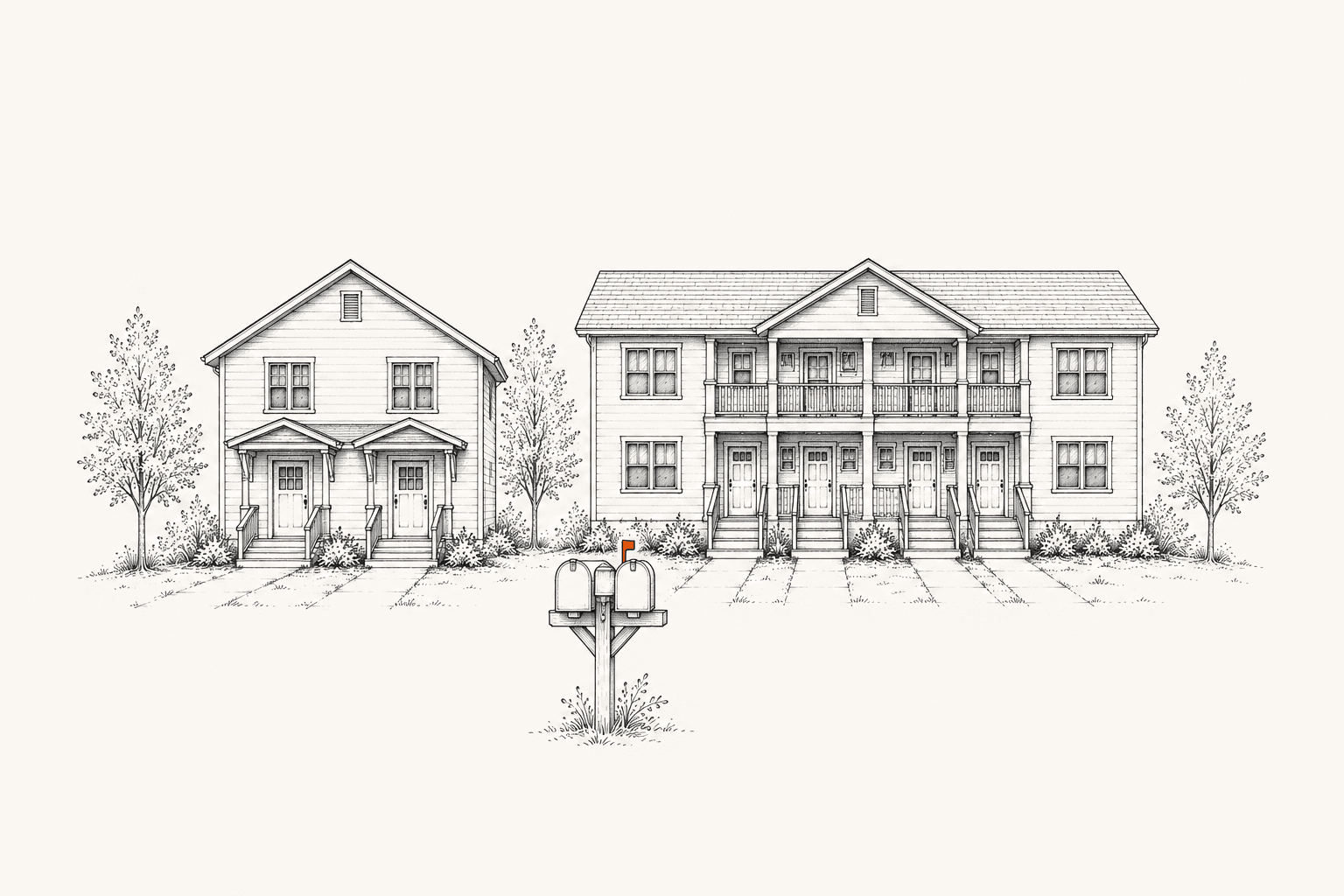
Multifamily home loans in Spokane cover two to four units and work like residential mortgages, not commercial ones. Live in one unit and you can buy with 3.5% down through FHA, 5% conventional, or zero with VA, and most of the other units' rent counts as your income. Pure investors plan on 20% to 25% down.
Two to four units is residential. Five is not.
This line decides everything else on the page. A duplex, triplex, or fourplex is a residential property in the eyes of Fannie Mae, Freddie Mac, FHA, and the VA. You get a 30-year fixed loan, you qualify on your income plus a share of the rent, and the down payment can be small if you live there. A building with five or more units is commercial real estate: shorter terms, balloon payments, and underwriting built on the property's net operating income. I write residential loans. If your search turns up a six-unit in West Central, I'll hand you to a commercial lender I trust rather than force it.
Living in one unit: the three low-down-payment doors
This is the strategy people call house hacking, and Spokane's older neighborhoods were practically built for it. Three programs make it work.
FHA at 3.5% down. The workhorse. FHA insures two, three, and four-unit properties at the same 3.5% down and 580 credit floor as a single-family home. The 2026 FHA limits for Spokane County and Kootenai County are $693,050 for two units, $837,700 for three, and $1,041,125 for four, which covers nearly every small building listed here. Mortgage insurance stays for the life of the loan with less than 10% down, and three and four-unit buildings must pass the self-sufficiency test described below. The FHA guide covers the rest of the program.
Conventional at 5% down. Fannie Mae dropped its down payment on owner-occupied two-to-four unit homes to 5% in late 2023, from the 15% to 25% it used to require, and that's still where it sits in 2026. You'll need a 620 or better score, six months of reserves after closing, and a ratio that works with 75% of the rent counted. PMI applies under 20% down and cancels at 20% equity, which FHA's insurance won't do. The 2026 conforming limits are $1,066,250 for two units, $1,288,800 for three, and $1,601,750 for four.
VA at zero down. Eligible veterans and active-duty service members can buy up to four units with nothing down and no monthly mortgage insurance, as long as one unit is your home. The VA counts 75% of the other units' rent toward qualifying when you have landlord experience or a property management agreement in place, and it asks for six months of reserves on three and four-unit buildings if rental income isn't used. With Fairchild ten miles west of downtown, I write these regularly. The VA guide has the funding fee and eligibility details.
How rental income counts toward your approval
On a two-to-four unit purchase, the appraiser completes a rent schedule (Form 1025) estimating market rent for each unit. Underwriting takes the units you won't occupy, applies a 25% haircut for vacancy and maintenance, and adds the remaining 75% to your income before running the debt-to-income ratio. Existing leases can be used instead when they're in place and documented.
Put numbers on it. Spokane's median rent runs around $1,500 a month. On a duplex, the other side at $1,500 adds $1,125 to your qualifying income. On a fourplex where you live in one unit, three units at $1,500 add $3,375. That's the mechanism that lets a household that qualifies for a $425,000 single-family home qualify for a $600,000 fourplex instead, with a lower net housing cost. The affordability guide walks through the ratio math this plugs into.
Two rules keep people honest. The rent number is the appraiser's, not the listing's, and appraisers in this market are conservative. And your own unit's rent never counts as income on a conventional or VA loan; you're living there, not renting it.
FHA's self-sufficiency test on three and four units
FHA adds one more gate on triplexes and fourplexes: 75% of the appraiser's market rent for all units, including yours, has to cover the entire monthly payment with taxes, insurance, and mortgage insurance. The building has to carry itself on paper even though you'll occupy a quarter of it.
Duplexes skip the test, which is why they're the easiest first building to finance. On a fourplex, the test is usually what decides whether the deal works, and it's driven by the rent-to-price spread in the neighborhood. A Hillyard or East Central fourplex at a moderate price with four units renting near market tends to pass. A newer Kendall Yards fourplex priced on its finishes tends not to, and the fix is a bigger down payment or a conventional loan, which has no such test.
A worked Spokane example
Take a $525,000 duplex in the Logan neighborhood near Gonzaga, both units around 1,000 square feet, the other side renting at $1,500. With FHA at 3.5% down, you bring $18,375 plus closing costs, some of which a seller credit can cover. Property taxes at Spokane County's 1.01% effective rate run about $442 a month, and insurance on a two-unit building lands near $150. Principal and interest depend on the rate your file prices at, so I run that figure in the calculator rather than printing one here.
On the income side, underwriting adds $1,125 a month from the other unit before it looks at your ratio. The building is well under the $693,050 FHA two-unit limit, there's no self-sufficiency test, and your net housing cost after the neighbor's rent is often below what you'd pay to rent a comparable apartment on the South Hill. That's a labeled estimate, not an approval. The real numbers come from the appraiser's rent schedule, your actual taxes and insurance, and the rate you lock, all of which I run before you write an offer.
Buying as an investor without living there
If you already own a home and want the building purely as a rental, the low-down-payment programs go away. A conventional investor loan on two to four units wants 25% down and underwrites on your tax returns plus 75% of the rent. A DSCR loan needs 20% to 25% down and skips your income entirely, qualifying the building on whether its rent covers its own payment. For investors with several properties or complicated tax returns, DSCR is usually the cleaner path, and there's no cap on how many you can hold.
Where the 2–4 unit buildings are in Spokane
The stock is older and concentrated. Browne's Addition and West Central have the highest density of converted mansions and purpose-built duplexes west of downtown. Logan and the blocks around Gonzaga run heavy on duplexes and triplexes with student demand. The Perry District and East Central have craftsman doubles and a few fourplexes at prices that still pencil. Hillyard has the widest rent-to-price spread in the city, which is exactly what the self-sufficiency test rewards. Spokane Valley adds newer duplexes off Broadway and Sprague, and Cheney's rentals near Eastern Washington University turn over on the academic calendar.
Across the state line, Coeur d'Alene's midtown and Post Falls have smaller inventories of two-to-four unit buildings, but Kootenai County's 0.6% effective property tax rate improves the numbers on the ones that come up. I'm licensed in both states, and the programs don't change at the border.
What to check before you write the offer
- Legal units. A "duplex" with a basement apartment that was never permitted is a single-family home to the appraiser. City of Spokane zoning and permit records take a few minutes to check, and I do it before we count any rent.
- Occupancy timing. Owner-occupied programs expect you in your unit within 60 days of closing and living there for 12 months. A tenant in the unit you plan to occupy needs a move-out date that works.
- Condition. FHA appraisals flag peeling paint, missing handrails, and roof issues on every unit, not just yours. Older Browne's Addition buildings need a sharper eye than a Valley duplex built in 2005.
- Reserves. Conventional wants six months of payments in the bank after closing on a two-to-four unit primary residence, and VA wants it on three and four units in some structures. Plan for it early.
- Refinancing later. Once you move out, the building becomes an investment property, and a future cash-out refinance will be priced as one. The original loan stays as it is.
How I run the numbers with you
Send me the listing. I'll pull the market rent, run the ratio with 75% of the rent counted, check the FHA limits and the self-sufficiency test if it's three or four units, and show you the FHA, conventional, and VA versions side by side. If you're comparing a Perry District duplex against a Hillyard fourplex, I'll run both. You'll know which building qualifies and what it costs you per month net of rent before you compete for it.
On the record
Frequently asked questions.
Can I buy a duplex in Spokane with an FHA loan?
Yes, and it's the most common way I see it done. FHA finances two, three, and four-unit properties at 3.5% down as long as you live in one of the units as your primary residence for at least a year. The 2026 FHA limits in Spokane County and Kootenai County are $693,050 for a duplex, $837,700 for a triplex, and $1,041,125 for a fourplex. Three and four-unit buildings also have to pass FHA's self-sufficiency test, which I explain below.
How much down payment do I need for a fourplex?
If you'll live in one unit: 3.5% with FHA, 5% with a conventional loan, or zero with VA if you're eligible. If you won't live there, plan on 25% down for a conventional investor loan or 20% to 25% for a DSCR loan that qualifies on the building's rent instead of your income. On a $700,000 fourplex, that's the difference between $24,500 down and $175,000 down, which is why the owner-occupied route is worth a year of living on site.
Does rental income from the other units help me qualify?
Yes. For a two-to-four unit purchase, underwriting counts 75% of the rent on the units you won't occupy, using the appraiser's rent schedule (Form 1025) or existing leases, whichever the program calls for. That income is added to yours before the debt-to-income ratio is calculated. On a Spokane duplex where the other side rents for $1,500, that's $1,125 a month of qualifying income you didn't have on a single-family purchase.
What is the 2026 loan limit for a duplex in Spokane County?
$1,066,250 for a conventional conforming loan on a two-unit property, $1,288,800 for three units, and $1,601,750 for four. Those are the 2026 baseline limits and they apply in both Spokane and Kootenai counties. FHA's limits are lower: $693,050, $837,700, and $1,041,125. Almost every 2–4 unit building listed in Spokane sits well under both sets of numbers.
Can I use a VA loan on a triplex or fourplex?
Yes, up to four units, with zero down and no monthly mortgage insurance, as long as you occupy one unit. The VA counts 75% of the rent from the other units if you have landlord experience or a signed agreement with a property manager, and it wants six months of reserves on three and four-unit buildings when rental income isn't being used to qualify. For Fairchild families, it's often the strongest way to buy a first rental.
What is FHA's self-sufficiency test?
It applies to three and four-unit properties only. FHA takes the appraiser's market rent for all units, including the one you'll live in, multiplies by 75%, and requires that number to cover the full monthly payment with taxes, insurance, and mortgage insurance. If it doesn't, the loan amount has to come down or the deal has to change. Duplexes skip the test entirely, which is one reason they're the easiest first building to finance.
What's the difference between a fourplex and a five-unit building for financing?
Everything. One to four units is residential financing: the programs on this page, 30-year fixed terms, and underwriting on your income plus a share of the rent. Five or more units is commercial lending, with shorter terms, balloon payments, and the building's net operating income doing the qualifying. I do residential. If you find a five-unit in Browne's Addition, I'll point you to the right commercial lender rather than pretend it's a fit.
Do I have to live in the building forever?
No. FHA, VA, and owner-occupied conventional loans require that you intend to occupy for at least 12 months. After that you can move out, keep the loan in place, and rent your unit too. Plenty of Spokane investors bought their first duplex this way, moved to the next one a year later, and still hold the first on its original low-down-payment loan.
Still weighing it? The fastest way to a real answer