
The Spokane mortgage guides
DSCR Loans
Updated: August 2026
DSCR Loans in Spokane, WA.Qualify on Rental Income
Qualify on what the property earns, not what your W-2 says — that's the whole idea behind a DSCR loan.
Real numbers in about a minute — no credit pull, no spam.
or call (509) 230-3765
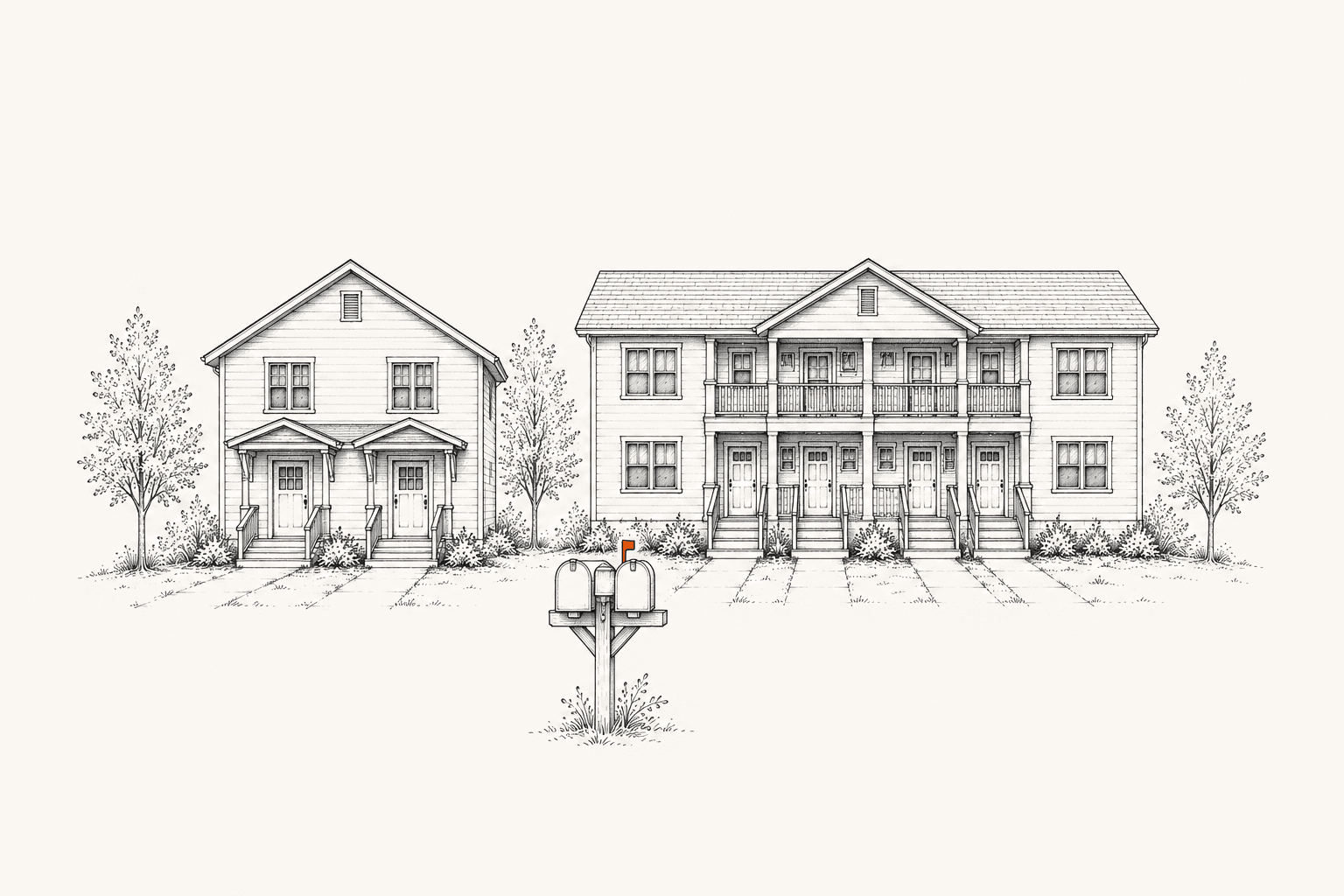
DSCR loans let Spokane and Coeur d'Alene investors qualify on the property's rental income instead of W-2s or tax returns. Typical terms run 20% down with a 620+ credit score, and the whole approval hinges on one number: does the rent cover the payment?
How the DSCR ratio actually works
DSCR is a simple fraction: monthly rent divided by PITIA — principal, interest, taxes, insurance, and any association dues. A ratio of 1.0 means the rent exactly covers the payment. Above 1.0, the property cash flows on paper. Below 1.0, you're subsidizing the mortgage out of pocket each month.
Here's a rough estimate using Spokane's median rent of $1,600 a month. If a South Hill duplex's PITIA runs $1,250, that's a 1.28 ratio — right in the middle of the 1.20 to 1.45 range I'm seeing regularly across South Hill and Browne's Addition right now. A Browne's Addition triplex with three units renting at $1,600 each against a $3,800 PITIA lands closer to 1.26. These are estimates, not underwriting — your actual ratio depends on the specific rent roll or market rent appraisal a lender orders for your property.
A worked example: South Hill duplex
Here's how the ratio plays out on a property type I run numbers on constantly. Take a $425,000 South Hill duplex, both units renting at $1,600 a month — Spokane's current median rent — for $3,200 a month in gross rent. At 20% down, the loan amount is $340,000. Principal and interest depend on the rate your file actually prices at, so I run that figure in the calculator rather than printing one here. On top of P&I, figure roughly $358 a month for property taxes at Spokane County's effective rate and about $124 a month for insurance to land at your PITIA.
$3,200 divided by a PITIA in the $2,660 range works out to about 1.20 — squarely inside the 1.20 to 1.45 window South Hill and Browne's Addition duplexes have been clearing regularly. This is a labeled estimate, not an underwriting number. Your actual ratio depends on the appraiser's Form 1007 rent schedule, your real tax and insurance figures, and the rate you lock — I run those specifics before you write an offer, not off a rounded example like this one.
Why Spokane pencils for investors
Spokane's median home price sits around $425,000 against that $1,600 median rent, and the ratio between the two is exactly why this market keeps attracting out-of-state investors. You're not paying Seattle or Boise prices for Eastern Washington rents — the spread between purchase price and rental income is wide enough that DSCR ratios routinely clear 1.20 without a stretch.
Kootenai County adds a second angle. Post Falls and Coeur d'Alene have seen strong, steady rental demand from people relocating for the lake, the outdoor access, and no state income tax on the Idaho side. Hayden and Rathdrum are catching some of that same overflow as CDA proper gets pricier. If you're comparing a Spokane County duplex against a Post Falls single-family rental, I can run DSCR numbers on both — the math doesn't care which state the property sits in.
Kendall Yards and the Perry District round out the neighborhoods I get asked about most. Both have seen enough new construction and walkable amenity growth over the past few years that rents have kept pace with rising purchase prices, which keeps DSCR ratios from compressing the way they can in markets where prices run ahead of rent. Hillyard is worth a look too — entry prices run lower relative to rent than South Hill, which can push a well-bought duplex or fourplex north of 1.30 without much effort. Spokane Valley tells a similar story: purchase prices trail the city core while rents hold steady, which is exactly the combination DSCR underwriting rewards. None of this is a guarantee on any one property — every deal gets its own rent roll or market rent appraisal — but it's the backdrop that makes Spokane and Kootenai County a comparatively easy market to find a DSCR loan that pencils.
What lenders actually look at
Beyond the ratio itself, a few things move the needle on your terms:
- The rent figure itself. Underwriting works off the appraiser's Form 1007 rent schedule, not the listing's advertised rent or a Zillow estimate. That's the number that actually sets your ratio, and it can run lower than what a seller advertises.
- Ratio tier. 1.0 to 1.25 is the standard tier most lenders price around. Above 1.25, you'll usually see better rate and lower down payment options. Below 1.0 — a no-ratio or sub-1.0 loan — is still financeable in this market, just at a higher rate and often a larger down payment. I treat these as a real option, not a last resort, but I'm upfront that the terms are noticeably tighter.
- Reserves. Expect to show several months of PITIA in reserves, separate from your down payment. The exact number depends on your ratio and credit score — a 1.35 ratio with a 720 score needs a lot less cushion than a sub-1.0 file with a 640.
- Vesting. Buying through an LLC is standard practice on DSCR loans and doesn't complicate the file the way it can on conventional financing built around personal tax returns.
- Prepayment penalties. Many DSCR loans carry a 3 to 5 year prepay penalty in exchange for a better rate. You can typically buy that down, but it's a real tradeoff worth walking through with actual numbers before you commit, not something to decide on rate alone.
Most DSCR loans run 30-year fixed, though interest-only and 5/6 ARM structures show up more often here than on conventional financing — usually to help a tighter ratio clear the bar. Which structure makes sense depends on whether you're holding for cash flow or planning to refinance or sell within a few years, which is exactly the conversation to have before locking anything.
Scaling a portfolio without the conventional cap
Conventional financing bumps into a familiar wall: most agencies stop counting new applications once you're carrying ten financed properties, and that lending still follows the same $832,750 conforming loan limit as owner-occupied financing in Spokane and Kootenai counties. DSCR loans don't work that way. Each property is underwritten on its own rent and its own ratio, so your fifth, tenth, or twentieth door gets evaluated the same way your first one did — on whether the numbers work, not on how many loans you're already carrying. That's the structural reason serious investors move to DSCR financing once they've outgrown what conventional loans will allow.
When to talk to me first
If you're comparing a South Hill rental against something in Kendall Yards or the Perry District, or weighing a Post Falls purchase against a Coeur d'Alene one, send me the listing before you write the offer. I'll run the actual DSCR ratio off the real rent roll or market rent appraisal, tell you which ratio tier you land in, and flag the prepayment penalty tradeoff up front.
I work both sides of the state line, so whether the deal is in Spokane County or Kootenai County, the process and the underwriting standards don't change. If you want the full walkthrough of how these loans work in this market, or you're deciding between financing here versus Idaho, the guides below cover both — or just send me the address and I'll tell you where the numbers land.
On the record
Frequently asked questions.
What is a DSCR loan and who qualifies?
DSCR stands for debt service coverage ratio. Instead of verifying your personal income with pay stubs and tax returns, the lender looks at whether the property's rent covers its own mortgage payment. Investors, self-employed borrowers whose tax returns don't reflect their real cash flow, and anyone buying their fourth or fifth rental all tend to qualify more easily this way than through a conventional loan.
What DSCR ratio do I need?
1.0 means the rent exactly covers the payment. Most lenders want 1.0 to 1.25 for the best pricing, and I'm seeing 1.20 to 1.45 pretty regularly on well-chosen South Hill and Browne's Addition rentals right now. Below 1.0, you can usually still get approved — the rate and down payment just get less forgiving.
Can I buy through an LLC?
Yes, and most of my investor clients do exactly that for liability reasons. DSCR loans are built around the property's income, not your personal tax return, so vesting in an LLC doesn't complicate approval the way it can with a conventional loan.
How much down payment do I need for a DSCR loan?
Plan on 20% for a straightforward purchase with a solid DSCR ratio. I've placed some deals at 15% down for strong borrowers with excellent credit and reserves, and I've placed others at 25% when the ratio was tight or the credit score needed the cushion. I'll tell you which bucket your deal falls into before you write an offer.
What credit score do I need?
620 is the general floor I work with. Scores in the 700s open up better pricing and lower down payment options, and a 680 or higher usually moves you into the sweet spot for rate.
What documents does underwriting actually require for a DSCR loan?
An appraisal with a Form 1007 rent schedule is the backbone of the file — that's what sets your rent number, not the listing sheet. Beyond that, underwriting wants proof of reserves (several months of PITIA), entity documents if you're vesting in an LLC, and a clear look at any prepayment penalty you're agreeing to. No pay stubs, no tax returns, no W-2s.
Do DSCR loans have prepayment penalties?
Often, yes — a lot of DSCR loans carry a 3 to 5 year prepayment penalty in exchange for a better rate. You can usually buy that penalty down or waive it entirely, but it costs you in rate. I walk through both versions side by side so you're picking the tradeoff with your eyes open, not finding out about it at closing.
How many DSCR loans can I have at once?
There's no hard cap like the 10-property ceiling that shows up on conventional financing. Each DSCR loan is underwritten against that specific property's rent, not your total exposure across a portfolio, so scaling to a fifth, tenth, or twentieth door is a conversation about reserves and ratios — not a rulebook stopping you.
Does DSCR work in Coeur d'Alene and Kootenai County, not just Spokane?
Yes. I'm licensed in both Washington and Idaho, and DSCR guidelines don't change at the state line. Post Falls, Hayden, and Coeur d'Alene rentals all pencil the same way Spokane County ones do — it's the property's numbers that matter, not which side of the border it sits on.
What's the biggest mistake investors make with DSCR loans?
Running the ratio off the listing's advertised rent instead of the appraiser's Form 1007 schedule, then getting surprised when the real number comes in lower. A close second is skipping the prepayment-penalty conversation and forgetting that insurance and property tax figures shift over time — a stale estimate can turn a 1.25 ratio into something closer to 1.05. I walk through the real PITIA and the real prepay terms before you write an offer, not after.
Still weighing it? The fastest way to a real answer